Exporting to the EU? Place your production facility 35 km from the border
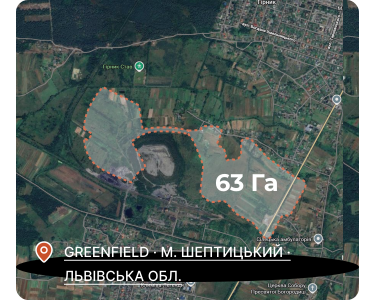
Greenfield plots in an industrial park 35 km from the Polish border. Land lease from €115/ha per month. 0% import duty and VAT on new production equipment.
Which closer-to-border development scenario fits your business?
Three development paths available to companies locating at Chervonohrad Industrial Park.
New production line
Would you like to place a new production line where the European market begins?
35 km to the Polish border shortens the logistics route to the EU. Long-term land lease with no land acquisition requirement, 0% import duty and VAT on new equipment, and lower upfront investment. Build-to-Suit format and available utility capacity enable a fast launch for a new export-oriented line.
New facility
Would you like to grow your business with a new facility closer to the border?
35 km to the Polish border shortens the logistics route to the EU. Long-term land lease with no land acquisition requirement, 0% import duty and VAT on new equipment, and lower upfront investment. Available utility capacity, a local labour pool, and community accommodation options support the launch of a large-scale facility.
Export preparation
Would you like to move packaging, packing, and export preparation closer to the border?
35 km to the Polish border shortens the logistics route to the EU. Long-term land lease with no land acquisition requirement lowers the entry threshold, while the Build-to-Suit format enables fast placement of packaging, packing, buffer stock, batch consolidation, or other export preparation operations closer to the border.
Select your sector and review the parameters most relevant to your business.
Select your sector and review the parameters most relevant to your business.
Agro-processing
Purposeful site zoning
The greenfield format and park zoning allow food production facilities to be positioned with sanitary buffer zones in mind, ensuring safe co-location.
Utility capacity
The park is designed with power, gas, water supply, and wastewater systems sized to the requirements of food production facilities.
Raw material base
Lviv Region has a diversified raw material base for agro-processing: grain, oilseeds, sugar beet, potatoes, and vegetables are produced at industrial scale.
Export logistics
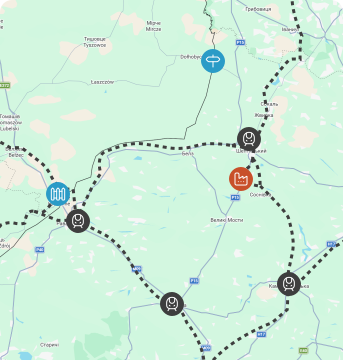
35 km to the Polish border, direct access to Roads P-15 and T-14-04, and a rail branch provide a short logistics route for EU export.
The greenfield format provides plots for manufacturing facilities of varying scales — from light assembly to more intensive manufacturing complexes with dedicated access roads and utility connections.
Engineering infrastructure
The park is served by power, gas, and water supply at the technical capacities required for manufacturing and textile production.
Technical labour base
The region retains the technical workforce legacy of the coal industry: mechanics, electricians, welders, and technical staff available for recruitment and reskilling.
EU distribution logistics
35 km to the Polish border and a rail branch enable direct outbound shipments of finished goods to EU markets.
What an exporter gets at Chervonohrad Industrial Park
35 km to the Polish border
Proximity to the border shortens the logistics route to the EU and accelerates outbound shipments of finished goods.
Flexible logistics
Direct access to Roads P-15 and T-14-04, and a rail branch, enable both truck and rail freight shipments.
Qualified labour pool
The community has a technical workforce legacy from the coal sector, reskilling capacity, and accommodation options for a relocated team.
0% import duty and VAT on new equipment
For new manufacturing operations, this reduces upfront investment — equipment, lines, and production systems can be imported under preferential terms.
Fast launch and low entry threshold
Long-term land lease with no land acquisition requirement and available utility capacity lower the entry threshold and shorten the time to production launch.
0% corporate income tax for up to 10 years
Subject to the reinvestment condition, tax-exempt funds remain with the company and are directed toward business development.
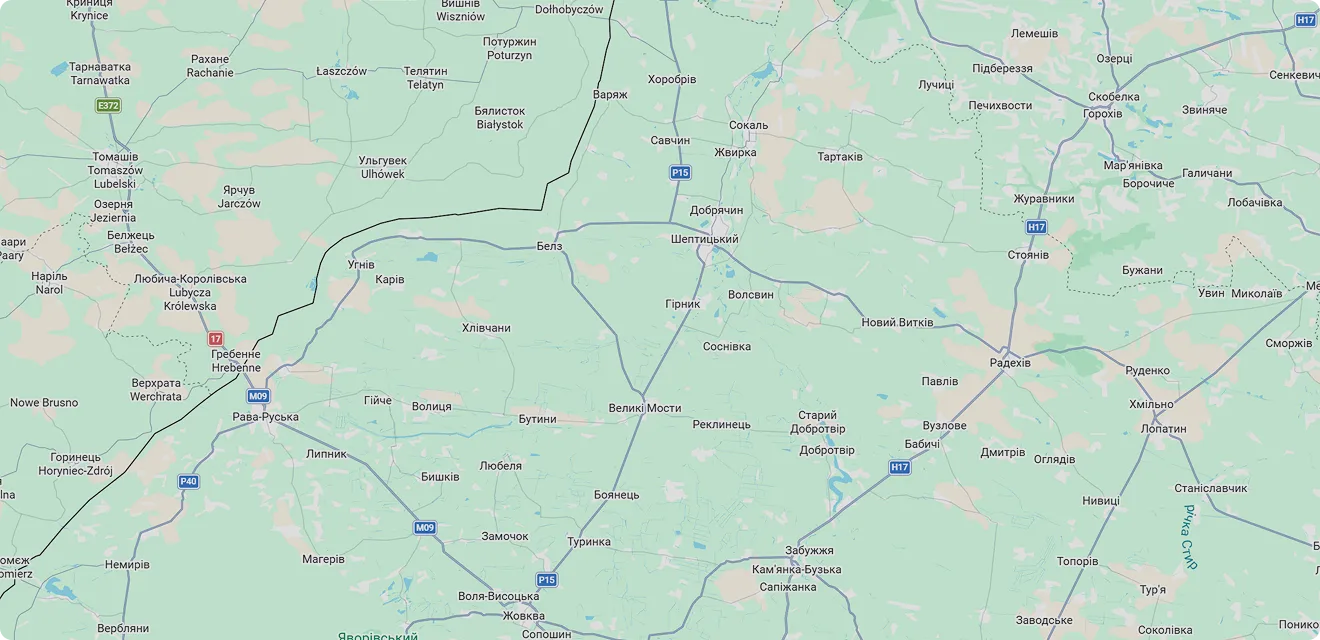
35 km to the EU border and direct rail access:what this means for logistics
Uhryniv border crossing (UA–PL)
~35 km(~40 min)
Lviv rail hub
~70 km(~1 hour)
Warsaw
~400 km(~5 hours)
Kraków
~370 km(~4 hours)
The park plots have direct access to Road P-15 (Kovel–Zhovkva). A rail branch runs along the park boundary, which is an additional advantage for manufacturers that rely on freight rail.
Financial Effect of Resident Status
How much capital stays in the business with industrial park resident status
Manufacturing business with annual profit of €500,000
*indicative example for illustration only
Standard regime
As an industrial park resident
Corporate income tax over 10 years
€900,000
€0
Import VAT and customs duty on equipment
20% VAT + import duty
€0
Access to a 1 ha industrial plot
100% of land acquisition cost
15–23% of land value over a 30-year lease term
Up to €900,000
can remain in the business over 10 years*
*Based on the corporate tax line only · subject to reinvestment of the tax-exempt amount within the park
*The 30-year lease equivalent is shown as the net present value (NPV) of annual lease payments using a 5–9% discount rate. Tax incentives are presented in accordance with Ukrainian industrial park legislation.
Trust & Legal Foundation
Who stands behind the project — and why that matters
The project is being developed within the just transition framework for the Chervonohrad coal region, supported in Ukraine by GIZ. This means international backing, institutional involvement, and the project's alignment with a long-term regional transformation agenda.
Official legal status
The park is officially registered under the Law of Ukraine "On Industrial Parks". It is established for at least 30 years, and the land-use model within the park has the legal foundation provided by Ukrainian legislation.
Regional transformation
The project is aligned with the economic transition of a former coal region: attracting new manufacturing, creating jobs, and building a new tax base rather than continuing to depend on the coal economy. This strengthens its alignment with local and regional development priorities.
Social Impact and Sustainable Development
Potential to create at least 990 direct jobs in the community
Potential to support approximately 1,000 additional jobs in related sectors
A new local tax base supporting the community's economy
Demand for reskilling the workforce of a former coal region for new manufacturing
Diversification of the regional economy and reduced dependence on the coal sector
ESG-compliant operations supported by a closed-loop water supply system and renewable energy readiness
Resident Roadmap
What the path to production launch looks like
1.
Initial enquiry
Short intake form, initial consultation, preliminary assessment of project parameters
1–3 days
2.
Plot selection
Site review, alignment on plot size, configuration, and initial placement terms
1–2 weeks
3.
Memorandum of intent
Signing of the memorandum of intent, alignment on core placement parameters, launch of the contractual structuring process
1–2 weeks
4.
Plot technical documentation
Preparation of land-management and technical documentation required for the land lease agreement
6–8 weeks
5.
Contractual entry
Legal formalisation of plot rights, signing of the land lease agreement, the economic activity agreement (park residency agreement under Ukrainian industrial park legislation), and the operating agreement
2–3 weeks
6.
Delivery of the production / logistics facility
Design, construction or fit-out, and connection to the park's engineering networks
12–18 months
Commissioning and start of operations
Q&A
Frequently Asked Questions
Manufacturing industries: food and agro-processing, wood processing, furniture, paper products, non-metallic mineral products, fabricated metal products, machinery and equipment, automotive and other transport. Scientific and technical activities are also permitted. Fit with park requirements is confirmed at the application review stage.
Prohibited activities include alcohol, tobacco, fuel, lotteries, gambling, overseas employment, industrial fishing outside Ukrainian jurisdiction, and activities involving narcotic drugs, psychotropic substances, and precursors. Exceptions among excisable goods include biofuel, biocomponents, alternative energy, and certain types of transport.
0% corporate income tax for up to 10 years; exemption from import customs duty and import VAT on new equipment and components; and potential land payment and property tax relief subject to local council resolution.
Profit must be directed toward development of operations within the park — toward equipment, construction, modernisation, or capacity expansion. Dividends are not accrued or paid during the period in which the tax benefit is applied.
New equipment and components with specified customs tariff codes (UKTZED) imported by a park participant for its own use within the park. The equipment must be unused, and no more than 3 years may have elapsed from its manufacture date to the import date.
Equipment is placed on the balance sheet within 20 business days of import, followed by quarterly reporting on its use. Disposal, lease, sublease, transfer to third parties, or any other non-targeted use is not permitted within 5 years of the import date.
Financing comes from multiple sources: state programmes, park management company funds, and resident investment. Specific available capacities, limits, and connection terms are confirmed at the time of negotiations.
The standard format is a long-term lease of up to 30 years with extension options. At a lease rate of 1.5% annually of the normative monetary value, the net present value of a 30-year lease is approximately 15–23% of the plot value.
The land is classified under land use classification code 11.02 (UKTZED): for the placement and operation of primary, ancillary, and auxiliary buildings and structures of processing, manufacturing, and other industrial enterprises.
By signing a land lease agreement or lease of another asset within the park, registering a Ukrainian legal entity or subsidiary within the park, and entering into an economic activity agreement with the park management company.
The park management company supports project delivery: it facilitates interaction with local authorities, coordinates engineering network connections, and can deliver a Build-to-Suit facility to the resident's specifications on request.
The park has access to a local labour pool: approximately 78,400 residents in the community, 6,700 internally displaced persons (IDPs), a technical workforce legacy from the coal sector, two vocational training institutions, and the potential for workforce reskilling to meet production requirements.
The community is home to enterprises in food processing, light industry, wood processing, furniture, and metalworking — forming a basis for production cooperation and local supply chains.
Such instruments are available through MIGA, DFC, and the Ukrainian ECA; specific coverage depends on the investment structure and project parameters.
Ready to discuss the terms for your manufacturing project?
Submit your enquiry — within one business day we will send you personalised placement terms and the technical parameters of available plots.